
The Modern Solution to Damaged Sewer Lines in Pueblo West
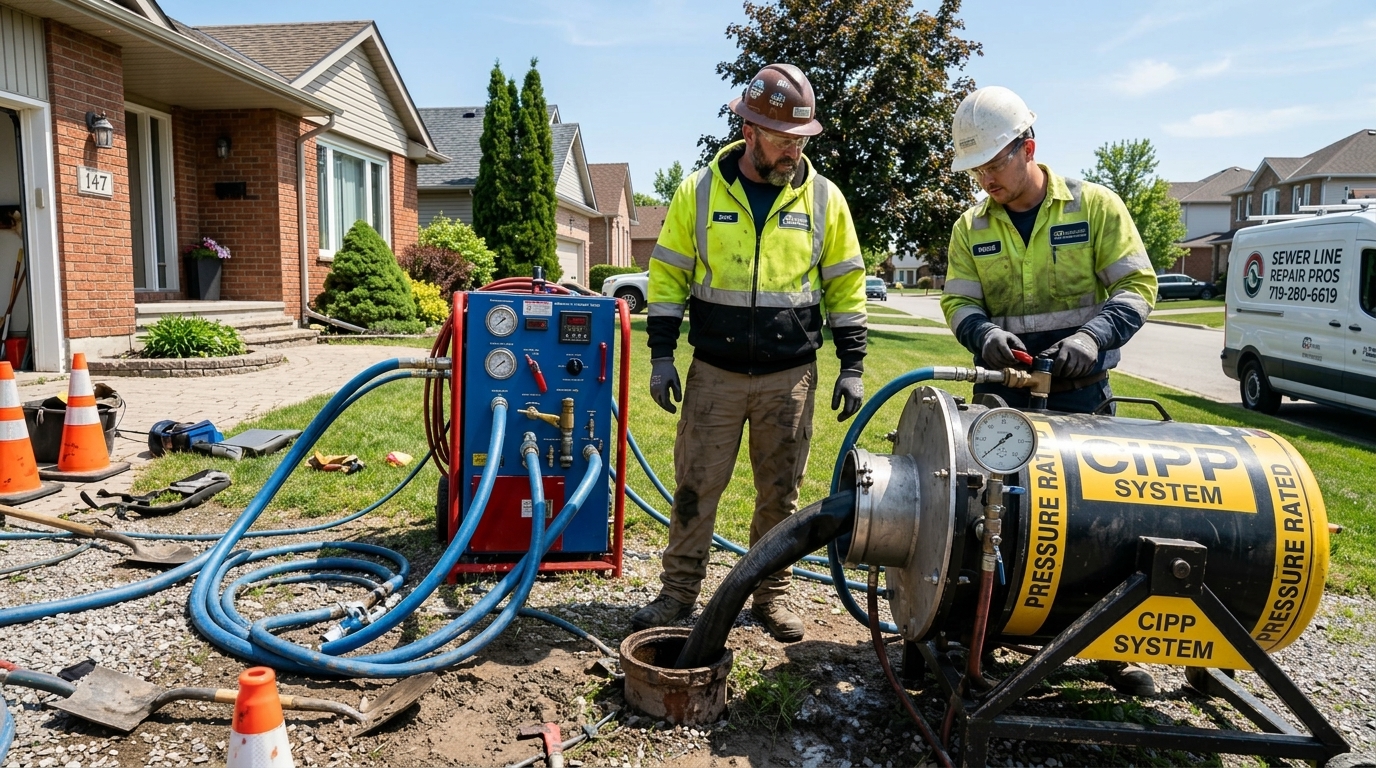
In past decades, repairing a broken sewer pipe beneath a Pueblo West front yard was an invasive nightmare. Backhoes excavated long, deep trenches across manicured bluegrass lawns, tore up decorative paver patios, destroyed asphalt driveways, and endangered century-old shade trees. After paying thousands for plumbing, homeowners faced thousands more in property restoration.
Today, as a leading pueblo west sewer repair company, Sewer Line Repair Pros offers cutting-edge trenchless sewer repair. Using structural Cured-In-Place Pipe (CIPP) technology and precision pipe bursting, we restore your underground sewer lateral without digging long trenches.
By accessing your system through an existing ground cleanout, we insert an epoxy-saturated seamless liner through the damaged pipe and inflate it against the interior walls. When the resin cures, it creates an entirely new structural pipe inside the old one—smooth, rock-hard, impervious to tree roots, and guaranteed for decades.
Engineered for Pueblo County’s Expansive Bentonite Clay
Traditional sewer piping uses rigid clay or cast iron bells fitted together every 2 to 5 feet. In Pueblo West and Fremont County (Florence and Cañon City), the ground is loaded with highly expansive Pierre shale and bentonite clay. When moisture levels shift, the soil expands and contracts with tremendous pressure, inevitably shearing those pipe joints apart.
Once a joint separates, wastewater leaks out and cottonwood or Siberian elm roots break in. Traditional spot repairs merely patch one joint while leaving neighboring joints vulnerable to the next season’s ground shift.
Trenchless CIPP lining solves this permanently. By creating a continuous, seamless composite cylinder throughout the entire run, it eliminates every single joint along your lateral. Even if the surrounding clay soil shifts, the monolithic epoxy pipe flexes naturally without leaking or breaking.
Our Step-by-Step CIPP Pipe Lining Process
Executing a flawless trenchless repair requires precision equipment and rigorous quality control. Here is how our certified technicians rehabilitate your pipe in a single day:
- Initial High-Definition Video Inspection: We begin by performing a comprehensive sewer camera inspection. We measure the exact length, diameter, and transition points of the lateral and confirm the pipe grade is intact.
- Mechanical Descaling & Hydro Jetting: Before installing a liner, the host pipe must be spotless. We use rotational chain-flail descalers and 4,000 PSI hydro jetting to strip away decades of rust scale, root masses, and grease, restoring the host pipe to maximum circular geometry.
- Epoxy Wet-Out & Calibration: We cut a customized fiberglass-reinforced felt liner to the exact linear footage of your sewer run. Using a vacuum-assisted wet-out table, we infuse two-part structural epoxy resin uniformly throughout every square inch of the felt.
- Pneumatic Inversion: Using controlled compressed air or water pressure through an inversion drum, we shoot the flexible resin sleeve inside the host pipe. The sleeve turns inside out as it travels, pressing the wet epoxy tightly against the host pipe walls.
- Curing & Solidification: We circulate steam or hot water through the bladder to activate the epoxy curing process. Within 2 to 4 hours, the resin hardens into a rigid, non-porous structural pipe with a rock-hard 50-year design rating.
- Robotic Reinstatement & Final Scope: If any interior tributary branches or stack lines connect along the lined run, a remote-controlled robotic cutting robot navigates downline to cleanly mill out the connection openings. We finish with a live video scope to verify 100% watertight perfection.
CIPP Pipe Lining vs. Pipe Bursting
While CIPP lining is our most common trenchless solution, pipe bursting is another valuable no-dig method when pipes are severely misshapen or when a homeowner desires to upsize pipe capacity.
| Feature | CIPP Epoxy Pipe Lining | Trenchless Pipe Bursting |
|---|---|---|
| Methodology | Inverts an epoxy-soaked felt sleeve inside the existing host pipe, forming a new inner shell. | Pulls a conical steel bursting head through the old pipe, shattering it outward while pulling a new HDPE pipe behind it. |
| Excavation Required | Zero digging. Installed 100% through an existing cleanout access point. | Requires two small insertion pits (roughly 4ft x 4ft) at either end of the lateral run. |
| Host Pipe Requirement | Host pipe must retain its general circular shape (no complete structural collapse). | Can replace completely collapsed, crushed, or disintegrated pipes. |
| Pipe Sizing | Maintains existing pipe size with negligible wall loss (~3mm). | Can upsize pipe diameter (e.g., expanding an older 4-inch line to a high-capacity 6-inch lateral). |
Does Your Sewer Line Qualify for Trenchless Repair?
Trenchless repair is suitable for approximately 80% of damaged residential sewer lines in Pueblo West. Qualifying conditions include:
If your sewer line has suffered a total physical cave-in (where dirt and rocks have completely filled the pipe) or has a massive negative-pitch "belly" where wastewater ponds for 20+ feet, trenchless lining cannot correct the underlying grade. In those specific scenarios, our crew recommends open-cut sewer line replacement.
Associated Sewer Services
Frequently Asked Questions
How long does a trenchless CIPP sewer lining last?
Cured-In-Place Pipe (CIPP) liners are manufactured from heavy-duty structural epoxy resin and felt carriers. They have an independently tested service life exceeding 50 years. Because the cured liner forms a continuous seamless cylinder with zero joints, tree roots cannot penetrate.
Will trenchless pipe lining reduce the diameter of my sewer pipe?
The epoxy liner thickness is only approximately 3mm to 4.5mm (less than 1/4 inch). Although it reduces interior pipe diameter by a negligible fraction, the ultra-smooth, glass-like interior surface drastically lowers hydraulic friction, which actually improves flow velocity and waste transit compared to rough cast iron or clay.
Can all broken sewer lines in Pueblo West be fixed with trenchless lining?
Trenchless CIPP lining requires an intact host pipe structure to support the resin sleeve during inflation and curing. If a pipe has suffered complete physical collapse, crushed segments, or a severe back-pitched belly where sewage pools, open-trench excavation or pipe bursting is necessary.
How long does the no-dig repair process take?
Most residential trenchless sewer linings in Pueblo West are completed in a single day. Cleaning and prep take roughly 2-3 hours, inversion takes 45 minutes, and curing takes 3-4 hours. Your plumbing service is typically restored by dinner.
How does trenchless repair handle branch connections or kitchen tie-ins?
After the main lateral liner cures, we deploy a high-speed precision robotic cutting tool equipped with an onboard camera down the pipe to seamlessly re-open ("reinstate") any incoming branch lines or cleanouts from the inside.